

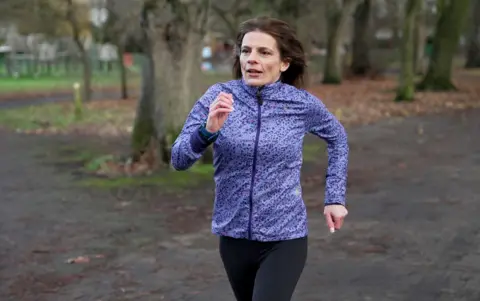
A sense of building tension. I can see the chilled vapour coming from my competitors as they do the "pre-race" wiggle on the beginning point.
A rapid movement of the hips.
I'm participating in my local 5km community parkrun and I'm serious. Three, two, one...
Hold on. I need to sort my watch. The same goes for the person alongside me.
The person behind us tuts. I'm not moving until… done! Connection established, away I go.
In the mele, it's challenging to spot a person without a wearable on it. And this extends beyond us participants who wear them.
We're witnessing a booming, multi-billion pound market. Brands like Apple Watch lead the market, featuring an extensive range of various models to fit a range of lifestyles. Depending on how feature-packed the device you go for, price tags can start from a hundred pounds to a significant investment.
"It makes me crazy, I can't switch off."
"It reassures me… It's like a supporter guiding me."
"Stop telling me I've had a poor sleep."
Just some of the comments I've had from like-minded device users when I ask what they their opinion is on theirs.
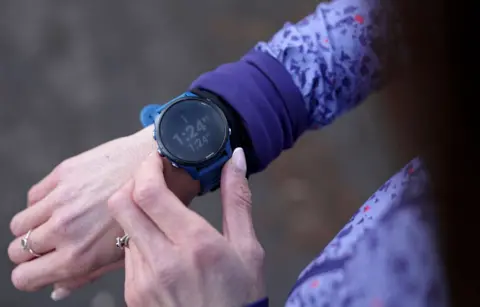
A Sea of Statistics
My thoughts on my own device? Currently, frustrating. It's telling me my speed is wrong, causing me to question whether the foliage I'm passing under are blocking my location tracking.
Countless individuals of us attach these little monitors onto our arms and wear them all day and night, apparently unconcerned with the fact they're constantly monitoring us.
Long past are the days when we depended on them exclusively to give us an rough count of our step count. Currently, they can analyse our sleep quality, stress levels, glucose levels, our body battery.
It's a challenge to find a physical metric they aren't designed to measure.
But can they do what they advertise? And are the statistics we analyse a faithful picture of our actual health? Do they enhance our overall health, or do the plethora of metrics and constant notifications just add to our daily stresses?

A Love-Hate Relationship
"I become a a little fixated with mine," an individual admits.
While she appreciates how her device tracks her workouts, she finds some of its other capabilities "excessive" at times - a feeling first discovered during a pregnancy.
Prior to discovering she could change its configuration, her smartwatch kept telling her she was being insufficiently energetic enough. Now, the watch keeps telling her she's had a poor sleep score.
"I have a young baby, it's unnecessary for me to be informed I've not slept," she says. "I'm acutely aware perfectly well."
Couldn't she just stop wearing it?
"I could, perhaps, but I have this push-pull dynamic with it," she continues. "I appreciate it for its exercise data, I sometimes question whether the myriad other functions it can now do is possibly too much for me."
The Technology Behind the Tracking
Each model of smartwatch has its own novel way of monitoring your bodily functions and interpreting your data, but the majority use detectors on the underside of the watch.
They typically project small, green LED lights onto your arm which can observe blood flow, recording your heartbeat. Sophisticated devices measure changes in the bioimpedance that passes over the skin to get an idea of your nervous system activity.
The Professional Viewpoint
A professor says that for most people for smartwatches, it's a "difficult line" - while the continuously improving tech could actually aid early diagnosis, "identifying issues before we show symptoms", it could also turn us watch wearers into the "anxious healthy".
He points out that newer wearables can carry out tests like electrocardiograms (ECGs), which regularly monitor how healthy the heart is. They can flag if someone is experiencing atrial fibrillation (AF), where there is erratic signals in the heart causing an irregular heartbeat.
This does not necessarily indicate someone is on the verge of a heart attack, but it can give an early warning they might be more at risk of a blood clot in the years to come.
But how to interpret these numbers is complicated. The expert worries that as more functions are incorporated, people may not be able to fully contextualise their data.
"I'm not entirely convinced that being able to monitor so many things is such a beneficial thing," he says.
A health researcher specialising in patient behaviour agrees. A study into the effect of wearable tech on a cohort of individuals with health issues suggested a significant portion of those who were given devices to monitor their cardiac function experienced greater stress and were "had a higher tendency to use medical services".
She noted a cycle with her patients - they spotted a concerning reading on their watch. They felt anxious. Their BPM rose. They got more worried. They looked a second time, and their reading increased again.
"If we see stats about ourselves that we don't really understand then, understandably, we are going to become concerned," the psychologist says. "We look, we re-check - it becomes a vicious cycle."


